

Why Are So Many Workers Still Choosing Remote Work Post-Pandemic?
.
.
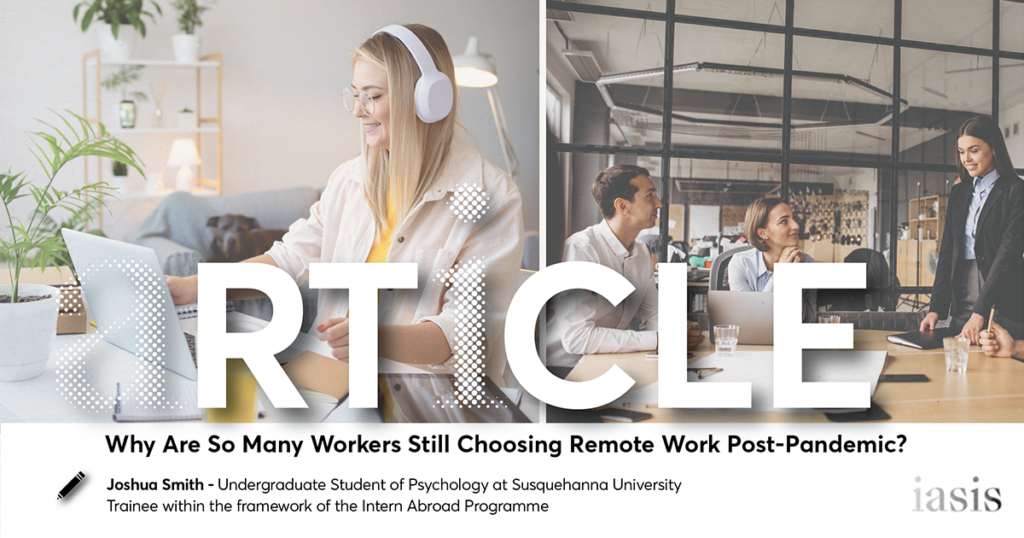
In 2019, millions of people across the globe were forced to make the transition to remote work due to the COVID-19 pandemic, and the world stayed this way for all of 2020 and 2021. Once 2022 came, the world finally started slowly returning to how it was; remote work started becoming hybrid work, and eventually back to full time in person work. For most people, this was the case. Even now in 2026, there is still a large number of people who work hybrid and remote full time. This marks the question, why would people who became remote workers choose to stay remote? Is the quality of life offered by remote work better than that of in-person work?
A survey conducted in the United States showed that some people viewed a full return to the office as significantly stressful, and that they have started to prefer hybrid and remote work. However, this is not true for everybody. Many of those who preferred fully remote work were employees who had a choice in going remote, rather than those who were forced or mandated into remote work.
For many people, remote work was a thorn in their side rather than a blessing, these are the people who enjoy their work environment, co-workers, and daily workload.
Many of these people use work as a main source of socialization, and form close bonds with co-workers. Some also gain a great sense of fulfillment from going to work, making progress on projects, working collaboratively with others, and doing their part to be the best version of themselves. It is these people that suffered the most when the pandemic began and remote work became mandatory. These are the people who took the first chance they could to start going back to the office.
As for those who chose to stay remote, there is a variety of both practical and psychological reasons people could have chosen this path.
One practical reason would be increased autonomy. Being remote, in most cases, gives workers more options for better work hours and more freedom to choose how their work gets done.
Improved work mentality is a significant psychological factor. For many people, remote work has made them more productive. This is because remote work creates a less stressful and more comfortable environment. People can work from the comfort of their own homes without any of the stressors of a traditional office setting. This has been very beneficial for the mental health of many employees.
Another practical reason is saving time and money. Some people spend hundreds each month on gas for commuting to work, and for some jobs, commuting during the workday as well. With remote work, people will be able to save all that money, or even use it to enjoy all the time they save by not commuting to and from work each day.
Studies also confirm that remote work is directly linked to an overall decrease in psychological stress and stress responses as well as decreased workplace exhaustion. These studies also state that remote workers show fewer depressive symptoms than those who work full-time in offices. These significant psychological benefits clearly illustrate a net gain for the mental health and overall wellbeing of employees.
However, it should be noted while there are many benefits, remote work is not a flawless solution. One of the most important factors to this is socialization. Remote workers can still work collaboratively with others, but they lose the authentic socialization that face-to-face contact offers, and this can have a negative impact on their mental health and cognitive functioning.
Additionally, some people do not have a home environment that is work friendly like an office. Many people have animals, small children, roommates, loud appliances, and other distractions that may impair their focus, and more importantly, take their time and attention away from important work. This can quickly lead to a large increase in stress, leaving people frequently feeling burnt out from remote work.
It is also worth note that remote work can have physical downsides such as neck pain, back pain, and other physical discomforts. Not everyone has furniture is made to be sat in for extensive periods, and they may not be ergonomically designed for working. Nor does everyone have access to furniture that is ergonomically designed for working.
The downsides make it clear that remote work is not for just anyone. It is highly dependent on one’s occupation and lifestyle. This leads many people to choose hybrid work, spending some days at work and others at home. It serves as a “best of both world” option, and for many people gives them the socialization and work friendly environment of a traditional work setting, while also offering the flexibility and low-stress workflow of remote work.
In summary, the COVID-19 pandemic caused a major shift in work culture and forever changed what people consider a normal work schedule. Many people, after experiencing remote work, have decided they now prefer it to in-person work because of the many practical advantages and mental health benefits it presents. This increased retention on remote work has already led to remote and hybrid work to become mainstream in many industries across the world, and will likely continue to grow even more.
.
Joshua Smith
Undergraduate Student of Psychology at Susquehanna University
Trainee within the framework of the Intern Abroad Programme
.
References
- Dávila Morán, R. C. (2023). Influence of remote work on the work stress of workers in the context of the COVID-19 pandemic: A systematic review. Sustainability, 15(16), 12489. https://doi.org/10.3390/su151612489
- Emil, J., Evaluating the Effect of Future Workplace and Estimating the Interaction Effect of Remote Working on Job Stress (2024). Mediterranean Journal of Basic and Applied Sciences, 8(1), 57-77. http://dx.doi.org/10.2139/ssrn.4761367
- Fan, W., Moen, P. (2023). Ongoing remote work, returning to working at work, or in between during COVID-19: What promotes subjective wellbeing? Journal of Health and Social Behavior, 64(1), 152-171. https://doi.org/10.1177/00221465221150283
- Perry, S. J., Rubino, C., & Hunter, E. M. (2018). Stress in remote work: two studies testing the Demand-Control-Person model. European Journal of Work and Organizational Psychology, 27(5), 577–593. https://doi.org/10.1080/1359432X.2018.1487402
- Shimura, A., Yokoi, K., Ishibashi, Y., Akatsuka Y., Inoue T., (2021). Remote work decreases psychological and physical stress responses, but full-remote work increases presenteeism. Front. Psychol., 12, 730969. https://doi.org/10.3389/fpsyg.2021.730969
- Tahlyan, D., Mahmassani, H., Stathopoulos, A., Said, M., Shaheen, S., Walker, J., Johnson, B. (2024). In-person, hybrid or remote? Employers’ perspectives on the future of work post-pandemic. Transportation Research Part A: Policy and Practice, 190, 104273. https://doi.org/10.1016/j.tra.2024.104273
- Wells, J., Scheibein, F., Pais, L., dos Santos, N., R., Dalluge, C., A., Czakert, J., P., Berger, R., (2023). A systematic review of the impact of remote working referenced to the concept of work-life flow on physical and psychological health. American Association of Occupational Health Nurses, 71(11), 507-521. https://doi.org/10.1177/21650799231176397
.